

Your Next Big Win Might Come From the Talent You're Still Developing

Three Key Takeaways From the 2026 Home Run Derby and
How it Relates to Your Organization

On Monday night, baseball history was made and, regardless of your allegiance to a team or how much you might even care about the sport of baseball, there is a major lesson to be learned by the performance of St. Louis Cardinals’ own Jordan Walker.
Organizations and their leaders may assume that their biggest wins will come from their most recognizable top performers. Walker’s story and his win of the 2026 Home Run Derby remind us that breakthrough performance can come from new talent with a past track record of shaky performance and a non-linear path to success.
Think of the Home Run Derby as a baseball version of a high-profile talent showcase. This annual one-night event invites MLB’s most accomplished power hitters across the league to compete against each other for a $1 million-dollar prize and the ultimate title of top slugger. As its name would suggest, players advance through head-to-head elimination rounds by hitting more home runs than their competitor until only one player remains. This year, that remaining player was 24-year-old Jordan Walker.
Walker, making his Major League debut only recently in 2023, received heavy criticism during his rookie year and was even sent back down to minors twice to improve home run hitting and manage the Cardinal’s roster. Being called up to the majors is a major achievement for these baseball players, for most that is a life-time achievement. Being sent back down to the minors after arriving at the majors can signal that a player has failed to establish themselves, and for many it is a pivotal crossroads in their career.
Imagine finally landing your dream job after years of preparation, only to be told a few months later that you're being moved back to an entry-level role because you aren't ready yet. In workplace terms, being promoted from the minors to the majors is like earning a coveted executive-track role after years of being identified as high potential talent. Being sent back down is like being told, "We still believe in your potential, but you're not ready for this level yet." Many employees would see that as a failure. The best ones see it as development.
So how exactly did Walker pull off winning the Home Run Derby title just two years after being sent down to the minors? Here are three key takeaways to consider from the Derby this year and what leaders should consider when having tough performance conversations with their own developing talent.
Takeaway #1: The Cardinals Had Baseball Legends for Decades, Yet Jordan Walker Became Their First Derby Winner
Lesson: Developing talent requires honest feedback and continued investment.
My bias for the St. Louis Cardinals might be showing here, but many baseball lovers consider the Cardinals to be one of the most iconic clubhouses. As an organization that has won the second-most World Series championships (11 titles) and developed baseball legends such as Albert Pujols (pictured below with Walker), the Cardinals have been long synonymous with talent development and excellence. Despite the generations of talent, Walker being the first Cardinal to ever win the Home Run Derby makes the story even more compelling.

Why do organizations believe that success will come from their most established stars? In the analogy here, wouldn’t it make sense that Pujols with over 700 career home runs would win the Derby at least once? The answer isn't that Walker is a better player than Pujols. It's that breakthrough achievements don't always come from the people with the biggest reputations, longest résumés, or greatest accomplishments. Sometimes they come from emerging talent whose full potential is still unfolding.
Many organizations fall victim to what psychologists call the halo effect. Once an employee develops a strong reputation or desirable quality, it may be implicitly assumed that future success will come from that individual. Meanwhile, emerging talent may receive less attention, fewer opportunities, and therefore less visibility or recognition for their performance.
By demoting Walker to the minors a few years back and focusing on his development and potential impact, the organization did him a kindness. How can one exceed expectations if there are not honest conversations and actions of accountability around this shared expectation of successful performance?
Regardless of an organization’s size, industry, or role, it is a leader's responsibility to identify potential, provide candid feedback, create opportunities for growth, and invest in development rather than simply rewarding current performance. Too often, leaders avoid difficult conversations in an attempt to be supportive, when in reality, the most supportive thing they can do is provide clear expectations and developmental guidance.
It makes sense to assume that past performance predicts future performance. In many cases, it does. However, context matters, growth happens, and there are very few absolute truths in business. An employee's past performance tells us where they have been, but it doesn't always tell us where they are capable of going. Great leaders recognize the difference between evaluating past results and identifying future potential.
Takeaway #2: Several Competitors Had Stronger Résumés
Lesson: Credentials and visibility are not the same as capability or potential.
Speaking of biases, let's not forget about the human tendency to confuse credentials with capability. Before the Derby even began, most fans would likely have predicted Schwarber or Harper to win given that the competition was in their home park (Citizens Bank), they are the top paid talent in the 2026 Derby lineup, Harper has previously taken home the Derby Title, both have appeared in past Derbies, and both lead the charge in Career Home Runs.
A Data Snapshot of the 2026 Home Run Derby Field
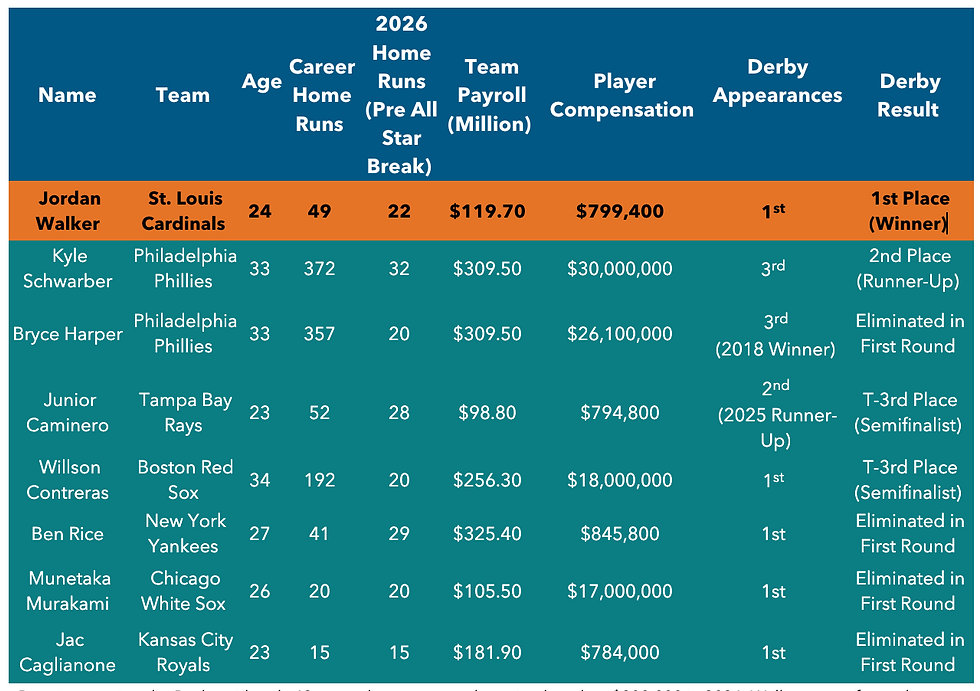
This illustrates a fallacy in decision making that leaders may face when making decisions about their talent. Indicators of success that are highly visible may also be easier to measure and therefore relied on to make talent decisions. Yet, as discussed above, past accomplishments and future potential are related, but distinct constructs.
Consider learning agility, which reflects an individual's ability to learn from experience, adapt to new situations, and effectively navigate ambiguity. Unlike compensation, tenure, or performance metrics, learning agility is not easily captured in a spreadsheet. Nevertheless, it is often one of the qualities that enables individuals to continue growing long after others have plateaued.
This is why performance and development conversations are so critical. Effective leaders do more than evaluate results. They seek to understand how employees learn, respond to feedback, overcome setbacks, and adapt to changing demands. Continuous dialogue about the how, what, and why behind an employee's growth helps leaders identify future potential, not just past performance.
Walker had multiple developmental reassignments, was among the youngest, inexperienced, and least paid, yet walked away with the Derby championship title. Walker's victory serves as a reminder that résumés tell us what someone has accomplished, but they do not always reveal what someone can accomplish next.

Takeaway #3: Walker was Booed Most of the Night
Lesson: Resilience is shaped by how people interpret and respond to pressure.
This takeaway may actually be one of the strongest lessons to walk away with after watching the 2026 Derby. And also, least surprising if you are slightly familiar with the Phillies fan base....
Walker competed in Philadelphia against hometown legends Kyle Schwarber (runner-up) and Bryce Harper. As a result, Walker was heavily booed throughout the competition by the sold-out crowd of over 43,000 fans. Take a moment to watch the first few minutes of the final round of the Derby. You may notice that the crowd is cheering for each of Walker’s fly balls (he’s not hitting a home run and therefore the Philly fans love that) and relentlessly booing at each one of his swings.
Here we can see a case study of resilience taking effect in the presence of resistance. Research shows how high-performing individuals are not those who avoid adversity but those who recover from it most effectively. Employees can view the same situation as a challenge, a hindrance, or a threat, and those different appraisals produce very different behavioral and well-being outcomes.
The difference between a challenge, a hindrance, and a threat isn't the situation itself. It's the story we tell ourselves about what the situation means. Walker appears to have interpreted a stadium full of boos not as a threat to his success, but as a challenge worthy of rising to meet.
Different Cognitive Responses to Workplace Stress

Before the Derby, a speech by Oliver Marmol in the Cardinal’s locker room nodded to Walker’s intrinsic motivation and his leader’s recognition of this motivation.
“Last week we talked about confidence. You borrow from results, disappear with the results. But when you draw it from who you’re becoming, nobody can take that from you dude, and this is a great example of that...” ~ Oliver Marmol, Cardinal’s Manager
Manager Marmol's message highlights an important distinction. Confidence rooted in outcomes is fragile. Confidence rooted in growth is resilient. When our sense of worth depends entirely on external validation, criticism, or setbacks, stress may be appraised as threatening. But when confidence is grounded in personal development and continuous improvement, adversity and the stress that comes with it become challenges worthy of overcoming.
Now let’s consider Walker’s response to the boos after winning the Derby title:
“You don’t boo nobodies.”
His now famous response suggests he didn’t see the crowd's reaction as evidence he didn’t belong, but rather proof that he did. Leaders can learn an important lesson from Marmol’s approach and Jordan’s mindset. When employees begin to define themselves by who they are becoming rather than by their most recent success or setback, they are better equipped to respond to criticism and perform under pressure.
One of the most overlooked indicators of future success is how people respond when support disappears. Walker succeeded not because conditions were favorable, but because he continued performing when they weren't. Marmol’s leadership wasn't just preparing Walker for the Home Run Derby. He was helping him develop the mindset necessary to thrive when the pressure arrived.
Walker’s Derby victory serves as a reminder that great organizations and leaders don’t just identify high performers, but they also actively take steps to help them achieve results. They provide coaching (have you checked out our Tell Them series?), create opportunities for growth, hold people accountable to shared expectations, and continue to believe in their potential when the path forward is not always clear. In doing so, they create conditions for future success rather than simply rewarding past success.


Comments